Thoroughly Engaging - Art Deco 18K White Gold Natural 'Old European Cut' Diamond Engraved Filigree Ring (ADR296)
Rarities Antique Jewelry
Thoroughly Engaging - Art Deco 18K White Gold Natural 'Old European Cut' Diamond Engraved Filigree Ring. This exquisite ring is crafted from 18K white gold, faint hallmark, and tested. Featuring one natural Old European cut diamond, Art Deco era styling, and quality craftsmanship. This antique ring showcases a beautiful Old European cut diamond, which is enhanced by engraved shoulders, and an exquisite filigree gallery. The engravings are deeply carved foliage decoration, whilst the filigree is open, and airy, displaying delicate milgrain detail. The shank is smooth and polished, which allows for a comfortable fit and easy sizing. This Art Deco era ring would make a perfect engagement ring, gift, or addition to any fine jewelry collection.
Comments: Lovely design, and condition. High quality diamond, and exquisite detail.
Note: Appraisal included with the ring. Contemporary appraisals do not reflect the antique value. Appraised at $2450.00 (Tax Excluded)
History: The earliest diamonds were found in India in 4th century BC, although the youngest of these deposits were formed 900 million years ago. A majority of these early stones were transported along the network of trade routes that connected India and China, commonly known as the Silk Road.
The Old European Cut, a historic diamond cut, evolved in Europe and gained popularity between 1890 and 1930, serving as a precursor to the modern Round Brilliant cut. It's characterized by its round shape, high crown, and a small table, offering a unique charm due to being hand-cut. This cut was especially popular during the Edwardian and Art Deco periods.
Holding a piece of jewelry that contains an antique diamond feels like you’re handling ancient treasure. And for good reason! While modern diamonds are mined and cut by the millions each year, a limited number of Old Mine and Old European Cut diamonds exist in the market today.
These precursors to our modern day round brilliant cuts offer a distinct visual experience from the way their hand cut facets play with light. The facets are wider and more geometric, resulting in pops of sparkle instead of the disco ball dazzle we see in modern diamonds. They’re perfectly imperfect, and that’s what gives them their charm.
In 1953, GIA formally created its diamond grading system, known as the 4 C's. The 4 Cs of diamond quality are the universally recognized diamond grading system still to be used today. 1n 1955, GIA presented its first diamond grading reports, which became the hallmark of grading reports in the diamond industry. Before this time in antiquity clients did not care about diamond grading. It was based more so on the size of the diamonds ( according to budget) , style, and sentiment. This ring is a wonderful rare example of the Art Deco, just beautiful!
People most likely first discovered gold in streams and rivers all over the world with its beauty and luster catching the eye. ... A few centuries later, around 1200 BC, the Egyptians discovered they could alloy gold with other metals in order to make it stronger and give it different color pigments.
Although the origin of white color gold dates back to 1710, where it was discovered by two alchemists in Germany, it wasn't used widely until much later. White gold as we know it today was really popularised in the 1920s. Although it might seem strange, this luxury material came to popularity in wartime.
Filigree began to be produced in Portugal in the 8th century with the arrival of Arab migrants, who brought new patterns with them. With time, the peninsula began to produce different filigree patterns, but while in Spain the filigree jewellery-making tradition became less relevant, in Portugal it was perfected.
Measurements: Face of the Ring 16.00 mm x 9.00 mm
Stone Size: Diamond (Old European Cut) .25 carats Clarity: VS1 Colour: G
Weight: 2.49 grams
Ring Size: 7 1/2
Condition: Excellent
Origin: America
Date: Circa 1920
You may also like...
-
 A Day In 1919 - Edwardian 14K Gold Natural Amethyst & Pearl 'Forget Me Knot' Engraved Filigree Ring (EDR105)
$2,995.00
A Day In 1919 - Edwardian 14K Gold Natural Amethyst & Pearl 'Forget Me Knot' Engraved Filigree Ring (EDR105)
$2,995.00
-
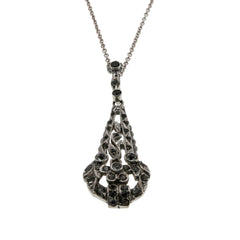 Birks - Art Deco German Sterling Silver Paste Pendant & Chain (ADP025)
$395.00
Birks - Art Deco German Sterling Silver Paste Pendant & Chain (ADP025)
$395.00
-
 Colour Symphony - Victorian 10K Gold Natural Australian Opal & Rose Cut Diamond Carved Cluster Ring (VICR187)
$1,495.00
Colour Symphony - Victorian 10K Gold Natural Australian Opal & Rose Cut Diamond Carved Cluster Ring (VICR187)
$1,495.00
-
 Contrasting Geometry - Vintage 14K Gold Natural Aquamarine, Sapphire & Diamond Filigree Ring (VR114)
$3,695.00
Contrasting Geometry - Vintage 14K Gold Natural Aquamarine, Sapphire & Diamond Filigree Ring (VR114)
$3,695.00
-
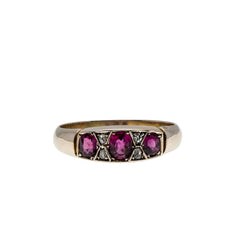 Crimson Trio - Victorian European 8K Gold Natural Ruby & Old Mine Cut Diamond Ring (VICR188)
$1,695.00
Crimson Trio - Victorian European 8K Gold Natural Ruby & Old Mine Cut Diamond Ring (VICR188)
$1,695.00
-
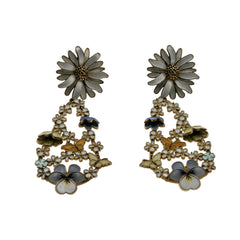 David Andersen - Estate 20K Gold Plate Over Sterling Silver Enamel Butterfly Flora Dangly Earrings (VE547)
$695.00
David Andersen - Estate 20K Gold Plate Over Sterling Silver Enamel Butterfly Flora Dangly Earrings (VE547)
$695.00