Jewelled Daisy - Edwardian English 18K Gold Platinum Natural Old European Cut Diamond Daisy Cluster Ring (EDR098)
Rarities Antique Jewelry
Jewelled Daisy - Edwardian English 18K Gold Platinum Natural Old European Cut Diamond Daisy Cluster Ring. This exquisite ring is crafted from 18K yellow gold, and platinum, hallmarked 18 (for 18CT) and PLAT (For Platinum). This ring features 7 natural 'Old European Cut' diamonds, Edwardian era styling, and high quality craftsmanship. The gallery on this ring is made of platinum in the form of a daisy, which is adorned by clear sparkling diamonds in the form of a charming flower cluster. The gallery exhibits traces of delicate milgrain decoration, adding character and detail to the piece. The band displays beautiful buttery yellow gold colour, and a smooth polished shank, which allows for a comfortable fit and easy sizing. This Edwardian ring would make a perfect engagement ring, gift, or a wonderful addition to any fine vintage jewelry collection.
Comments: Wonderful craftsmanship and detail. Lovely antique desirable daisy design with full hallmarks.
Note: Contemporary appraisals do not reflect the value of antique Jewelry. This is recommended that this ring be insured for $2200.00 (Tax Excluded)
History:The earliest diamonds were found in India in 4th century BC, although the youngest of these deposits were formed 900 million years ago. A majority of these early stones were transported along the network of trade routes that connected India and China, commonly known as the Silk Road.
The Old European Cut, a historic diamond cut, evolved in Europe and gained popularity between 1890 and 1930, serving as a precursor to the modern Round Brilliant cut. It's characterized by its round shape, high crown, and a small table, offering a unique charm due to being hand-cut. This cut was especially popular during the Edwardian and Art Deco periods.
In 1953, GIA formally created its diamond grading system, known as the 4 C's. The 4 Cs of diamond quality are the universally recognized diamond grading system still to be used today. 1n 1955, GIA presented its first diamond grading reports, which became the hallmark of grading reports in the diamond industry. Before this time in antiquity clients did not care about diamond grading. It was based more-so on the size of the diamonds ( according to budget), rarity, style, desirability, and sentiment.
The name is derived from the Spanish platina, meaning "silver." Platinum was discovered in South America independently by Antonio de Ulloa in 1735 and by N. Wood in 1741, but it had been in use by pre-Columbian natives.
Gold was generally used for a couple thousand years solely to create things such as jewelry and idols for worship. This was until around 1500 BC when the ancient empire of Egypt, which benefited greatly from its gold-bearing region, Nubia, made gold the first official medium of exchange for international trade.
The Edwardian era corresponds to the reign of King Edward VII in Great Britain, whose short-lived governance (1901-1910) followed Victoria's long reign and preceded the modern House of Windsor in England. The "Edwardian" style broadly encompasses the years of 1901 through to 1919.
Measurements: Face of the Ring 8.50 mm x 8.00 mm
Stone Size: Diamond (Old European Cut) .21 carats
Weight: 2.20 grams
Ring Size: 7 1/2
Condition: Excellent
Origin: England
Date: Circa 1910
You may also like...
-
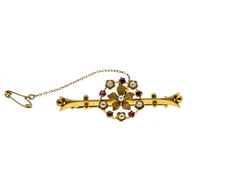 A Promenade in 1908 - Edwardian English 15K Gold Pink Sapphire & Natural Pearl Brooch (EDBR005)
$895.00
A Promenade in 1908 - Edwardian English 15K Gold Pink Sapphire & Natural Pearl Brooch (EDBR005)
$895.00
-
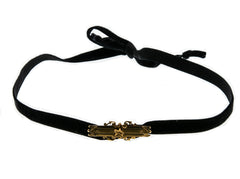 Age of Elegance - Edwardian English 'Dated 1905' 9K Gold 'Ivy Leaf' Black Velvet Choker Necklace (EDN024)
$695.00
Age of Elegance - Edwardian English 'Dated 1905' 9K Gold 'Ivy Leaf' Black Velvet Choker Necklace (EDN024)
$695.00
-
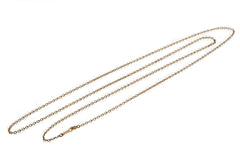 Antique Must Have - Edwardian 10K Rose Gold Belcher Chain (EDN026)
$995.00
Antique Must Have - Edwardian 10K Rose Gold Belcher Chain (EDN026)
$995.00
-
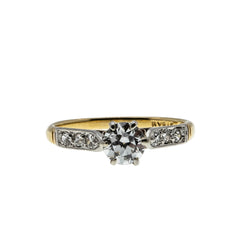 Antique Proposal - Edwardian Signed 'Ryrie' 18K Gold Natural Old European Cut Diamond Engagement Ring (EDR093)
$3,995.00
Antique Proposal - Edwardian Signed 'Ryrie' 18K Gold Natural Old European Cut Diamond Engagement Ring (EDR093)
$3,995.00
-
 Birks - Edwardian Sterling Silver Paste Filigree Pin Brooch (EDBR004)
$125.00
Birks - Edwardian Sterling Silver Paste Filigree Pin Brooch (EDBR004)
$125.00
-
 Blue Horizon - Edwardian European 14K Gold Natural Aquamarine & 'Old European cut' Diamond Filigree Ring (EDR096)
$3,995.00
Blue Horizon - Edwardian European 14K Gold Natural Aquamarine & 'Old European cut' Diamond Filigree Ring (EDR096)
$3,995.00