Recently Sold (ADR267)
Rarities Antique Jewelry
Sorry, this item is Sold
Devine Amethyst Three Colour - Art Deco 14K White, Yellow & Rose Gold Natural Amethyst & Pearl 'Forget-Me-Not' Filigree Ring. This glorious ring is crafted from 14K white, yellow, and rose gold, hallmarked and confirmed 14K. The ring features one natural oval cut faceted amethyst gemstone, 42 natural seed pearls, Art Deco era styling, and high quality craftsmanship. The gallery on this ring is expertly bezel set with a beautiful purple amethyst, displaying purplish/bluish hues. The gold bezel showcases a delicate milgrain and twisted rope decoration, adding even more detail to the ring. The bezel is surrounded by a wonderful natural pearl hand-wired surround (A characteristic sometimes seen on ancient jewelry). The pearls display a beautiful silvery white colour, and a wonderful lustre. The gallery also exhibits an exquisite sea of filigree and detail, which include rose gold forget-me-knots, and engravings. The shoulders display engraving and raised yellow gold scrolls. The shank is smooth and polished, which allow for a comfortable fit, and easy sizing. This Art Deco era ring looks stunning when worn, truly a piece to be cherished and enjoyed for a lifetime and beyond.
Note: Contemporary appraisals do not reflect the value of antique jewelry. It is highly recommended that this ring be insured for $4300.00 (Tax Excluded)
History: Ancient Greeks and Romans believed this gemstone could ward off the intoxicating powers of Bacchus and keep the wearer clear-headed and quick-witted. English regalia were decorated with amethysts during the Middle Ages to symbolize royalty. Amethyst jewelry has been found and dated as early as 2000 BC.
Pearls were presented as gifts to Chinese royalty as early as 2300 BC, while in ancient Rome, pearl jewellery was considered the ultimate status symbol. So precious were the spherical gems that in the 1st century BC, Julius Caesar passed a law limiting the wearing of pearls only to the ruling classes.
Gold was generally used for a couple thousand years solely to create things such as jewelry and idols for worship. This was until around 1500 BC when the ancient empire of Egypt, which benefited greatly from its gold-bearing region, Nubia, made gold the first official medium of exchange for international trade.
White gold has been around since the turn of the 19th century, but it wasn't until the 1920s when it really started gaining popularity. At the time, platinum had been the preferred precious metal for jewellery. But it quickly became scarce as World War II raged on, and countries began to stockpile it for military use.
Rose gold was first used in early 19th century Russia by the famed jeweler Carl Faberge in his famous Faberge Eggs, as was known as Russian Gold. Rose gold later gained popularity in the United States during the lavish and feminine 1920's, and was worn in engagement rings and fine jewelry.
The first fossil instances of filigree were discovered by archaeologists in ancient Greece and Mesopotamia and dated over 5,000 years ago. The name filigree comes from the latin words “filum” meaning thread and “granum” meaning grain, describing the thin metal strips used to create filigree.
Forget-me-nots symbolize true love and respect. When you give someone these tiny blooms, it represents a promise that you will always remember them and will keep them in your thoughts. They are also considered a symbol of fidelity and faithfulness.
Measurements: Face of the Ring 22.00 mm x 17.00 mm
Stone Size: Amethyst 7.38 carats Clarity VS Seed Pearls 2.00 mm -2.50 mm each
Weight: 7.22 grams
Condition: Very Good Note: Very slight age related wear.
Ring Size: 6 1/4
Origin: America
Date: Circa 1920
You may also like...
-
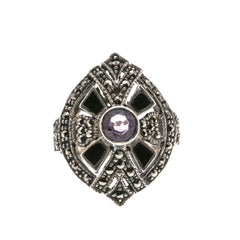 Art Deco Geometry- Vintage Sterling Silver Amethyst, Onyx & Marcasite Ring
Sold
Art Deco Geometry- Vintage Sterling Silver Amethyst, Onyx & Marcasite Ring
Sold
-
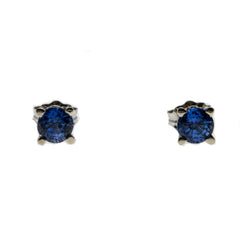 Brilliant Skies - Estate 14K White Gold Natural Blue Sapphire Stud Earrings (EE213)
Sold
Brilliant Skies - Estate 14K White Gold Natural Blue Sapphire Stud Earrings (EE213)
Sold
-
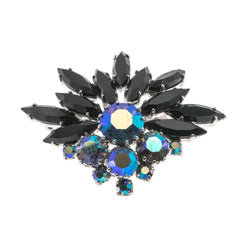 Contrasting Adornment - Vintage Silver Tone Aurora Borealis Crystal Brooch (VBR054)
Sold
Contrasting Adornment - Vintage Silver Tone Aurora Borealis Crystal Brooch (VBR054)
Sold
-
 Date Night - Vintage Retro Sterling Silver Intricate Bracelet (VB121)
Sold
Date Night - Vintage Retro Sterling Silver Intricate Bracelet (VB121)
Sold
-
 Glowing Nature - Estate Sterling Silver Freshwater Pearl CZ Ring (ER229)
Sold
Glowing Nature - Estate Sterling Silver Freshwater Pearl CZ Ring (ER229)
Sold
-
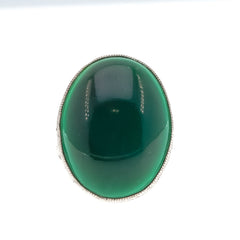 Rainforest - Art Deco Sterling Silver Chrysoprase Ring (ADR210)
Sold
Rainforest - Art Deco Sterling Silver Chrysoprase Ring (ADR210)
Sold