Recently Sold (VP219)
Rarities Antique Jewelry
Sorry, this item is Sold
Iesus Nazarenus Rex Iudaeorum - Vintage Italian Sterling Silver Crucifix Pendant & Chain. This wonderful crucifix is crafted from sterling silver, tested, and the chain is crafted from sterling silver, hallmarked 925 and Italy. The pendant features vintage styling, and quality craftsmanship. This beautiful vintage crucifix is crafted in 3 separate parts, which is comprised of a cross, Jesus, and the INRI symbol. Each component would have been crafted separately, as apposed to casted in one piece, therefore Jesus and the INRI symbol would have been applied to the cross (a characteristic of early vintage jewelry). The cross has an 'O' ring bale, which is substantial and sturdy enough for the pendant. The chain is a belcher/rolo design, which features a secure lobster claw clasp. The chain dates later than the cross, however it matches beautifully with the precious crucifix. This vintage crucifix pendant & chain would make a perfect gift or addition to any vintage jewelry collection.
History: Silver was discovered after gold and copper about 4000 bce, when it was used in jewelry and as a medium of exchange. The earliest known workings of significant size were those of the pre-Hittites of Cappadocia in eastern Anatolia.
The pound sterling's origins go back to Anglo-Saxon times, when a pound weight of silver was coined into 240 pennies. These pennies were made from an alloy that was 925 parts silver and 75 parts copper.
While early Christians avoided the use of even this simple cross, not to mention any rendering of Jesus' crucifixion, the cross came into use no later than the fifth century, with archaeological evidence placing the first surviving image of a crucified Jesus in fifth-century Rome.
The four letters are a titulus, Latin for label, inscribed above Jesus Christ on the Crucifix. They are the Latin initials for the phrase Pontius Pilate had written when he ordered Him to be crucified, as described in John 19:19-23. These words were “Iesus Nazarenus, Rex Iudaeorum” translating to English as “Jesus of Nazareth, the King of the Jews.” Latin uses “I” instead of the English “J”, and “V” instead of “U” (e.g., Jesus Nazarenus Rex Judaeorum).
“Pilate also had an inscription written and put on the cross. It read, “Jesus the Nazorean, the King of the Jews.” Now many of the Jews read this inscription, because the place where Jesus was crucified was near the city; and it was written in Hebrew, Latin, and Greek. So the chief priests of the Jews said to Pilate, “Do not write ‘The King of the Jews,’ but that he said, ‘I am the King of the Jews.’” Pilate answered, “What I have written, I have written.” – John 19:19-23
To answer the question of why Pontius Pilate had the phrase written on the cross requires knowledge of how ancient Rome meted out punishments. It was customary to set up over the heads of those sentenced to crucifixion a label indicating the crime for which they suffered and the name of the sufferer.
This is why the Gospel of John refers to it as an inscription and Gospel of Mark 15:26 refers to it as the charge brought against Him. Pontius Pilate had condemned Jesus on the charge he was claiming to be the King of the Jews.
The term Titulus Crucis, Latin for “Title of the Cross,” refers to the actual inscribed piece of wood that is a relic of the True Cross. During Saint Helena’s pilgrimage to the Holy Land, she brought with her a number of Church relics, including the Titulus Crucis.
The Basilica of the Holy Cross in Jerusalem was built about AD 325 for her to house these relics. Sometime before 1145, the relic was placed in a box bearing the seal of Cardinal Gherardo Caccianemici dal Orso, who became Pope in 1144 as Lucius II. It was forgotten until February 1, 1492, when it was discovered by workmen restoring a mosaic, hidden behind a brick with the inscription Titulus Crucis. Today, it is again housed in The Basilica of the Holy Cross in Jerusalem.
Measurements: Crucifix Pendant (Including the Bale) 61.00 mm x 32.00 mm Chain 22"
Weight: 12.10 grams
Condition: Excellent
Origin: Italy
Date: Circa 1940
You may also like...
-
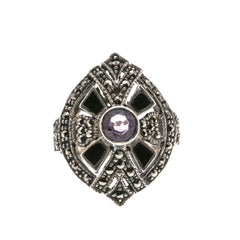 Art Deco Geometry- Vintage Sterling Silver Amethyst, Onyx & Marcasite Ring
Sold
Art Deco Geometry- Vintage Sterling Silver Amethyst, Onyx & Marcasite Ring
Sold
-
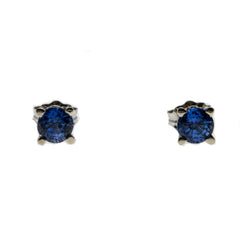 Brilliant Skies - Estate 14K White Gold Natural Blue Sapphire Stud Earrings (EE213)
Sold
Brilliant Skies - Estate 14K White Gold Natural Blue Sapphire Stud Earrings (EE213)
Sold
-
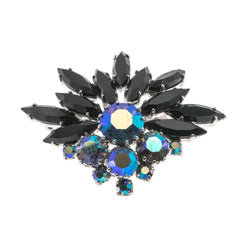 Contrasting Adornment - Vintage Silver Tone Aurora Borealis Crystal Brooch (VBR054)
Sold
Contrasting Adornment - Vintage Silver Tone Aurora Borealis Crystal Brooch (VBR054)
Sold
-
 Date Night - Vintage Retro Sterling Silver Intricate Bracelet (VB121)
Sold
Date Night - Vintage Retro Sterling Silver Intricate Bracelet (VB121)
Sold
-
 Glowing Nature - Estate Sterling Silver Freshwater Pearl CZ Ring (ER229)
Sold
Glowing Nature - Estate Sterling Silver Freshwater Pearl CZ Ring (ER229)
Sold
-
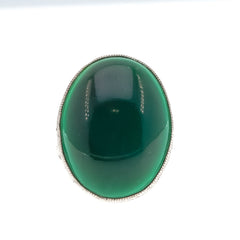 Rainforest - Art Deco Sterling Silver Chrysoprase Ring (ADR210)
Sold
Rainforest - Art Deco Sterling Silver Chrysoprase Ring (ADR210)
Sold