On This Day In 1941 - Vintage English 9K Gold Natural Sapphire & 'Old Mine Cut' Diamond Ring (VR1163)
Rarities Antique Jewelry
On This Day In 1941 - Vintage English 9K Gold Natural Sapphire & 'Old Mine Cut' Diamond Ring. This timeless ring is crafted from 9K yellow and white gold. Hallmarked 375 (British hallmark for 9K gold), Birmingham assay, and a letter date R for 1941. This ring features one natural oval shaped faceted sapphire, two natural old mine cut diamonds, classic vintage era styling, and quality craftsmanship. The gallery on this ring is crafted from white gold, which sets-off the gemstones beautifully. The sapphire is dark blue in colour, whilst the diamonds are of a lovely quality, and display a wonderful glow (a characteristic of antique cut gemstones). The dark blue sapphire and diamonds adds a perfect contrast to the ring, as does the yellow and white gold. The shoulders have a slight taper, and the band is smooth, and polished, which allows for a comfortable fit, and easy sizing. This vintage ring would make a unique engagement ring or perfect addition to any fine jewelry collection.
Note: Appraisal included with the ring. Contemporary appraisals do-not reflect the value of antique/vintage jewelry.
History: Diamond History The earliest diamonds were found in India in 4th century BC, although the youngest of these deposits were formed 900 million years ago. A majority of these early stones were transported along the network of trade routes that connected India and China, commonly known as the Silk Road.
Holding a piece of jewelry that contains an antique diamond feels like you’re handling ancient treasure. And for good reason! While modern diamonds are mined and cut by the millions each year, a limited number of 'Old Antique Cuts' exist in the market today.
The Old Mine Cut diamond, a historical style of diamond cutting, gained popularity in the late 18th centuries, particularly during the Georgian, Victorian, and Edwardian eras. Originally used to describe diamonds from older mines in Brazil and India, the term eventually encompassed any diamond cut in a similar squarish shape with a high crown, small table, and large culet. These diamonds were hand-cut and known for their unique, often asymmetrical, facets, which produced a softer, more subtle brilliance than modern cuts.
These precursors to our modern day round brilliant cuts offer a distinct visual experience from the way their hand cut facets play with light. The facets are wider and more geometric, resulting in pops of sparkle instead of the disco ball dazzle we see in modern diamonds. They’re perfectly imperfect, and that’s what gives them their charm.
In 1953, GIA formally created its diamond grading system, known as the 4 C's. The 4 Cs of diamond quality are the universally recognized diamond grading system still to be used today. 1n 1955, GIA presented its first diamond grading reports, which became the hallmark of grading reports in the diamond industry. Before this time in antiquity clients did not care about diamond grading. It was based more so on the size of the diamonds (according to budget) , style, and sentiment. This ring is a wonderful example of the Art Deco era, just beautiful!
In ancient Greece and Rome, kings and queens were convinced that blue sapphires protected their owners from envy and harm. ... In folklore, history, art, and consumer awareness, sapphire has always been associated with the color blue. Its name comes from the Greek word sappheiros, which probably referred to lapis lazuli.
Gold was generally used for a couple thousand years solely to create things such as jewelry and idols for worship. This was until around 1500 BC when the ancient empire of Egypt, which benefited greatly from its gold-bearing region, Nubia, made gold the first official medium of exchange for international trade.
Although the origin of white color gold dates back to 1710, where it was discovered by two alchemists in Germany, it wasn't used widely until much later. White gold as we know it today was really popularised in the 1920s. Although it might seem strange, this luxury material came to popularity in wartime.
Measurements: Face of the Ring 11.00 mm x 7.00 mm
Stone Size: Sapphire .58 carat Diamond (Old Mine Cut) .14 carats
Weight: 1.98 grams
Ring Size: 6 1/2
Condition: Excellent
Origin: England, Birmingham
Date: 1941 (Letter Date R)
You may also like...
-
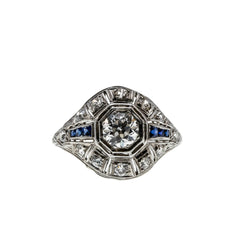 1920s Rarity - Art Deco Platinum Natural Old European Cut Diamond & Sapphire Ring (ADR301)
$6,495.00
1920s Rarity - Art Deco Platinum Natural Old European Cut Diamond & Sapphire Ring (ADR301)
$6,495.00
-
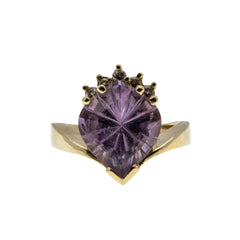 A Cut Above - Vintage 14K Gold Fancy Cut Natural Amethyst & Diamond Ring (VR917)
$1,695.00
A Cut Above - Vintage 14K Gold Fancy Cut Natural Amethyst & Diamond Ring (VR917)
$1,695.00
-
 A Day In 1919 - Edwardian 14K Gold Natural Amethyst & Pearl 'Forget Me Knot' Engraved Filigree Ring (EDR105)
$2,995.00
A Day In 1919 - Edwardian 14K Gold Natural Amethyst & Pearl 'Forget Me Knot' Engraved Filigree Ring (EDR105)
$2,995.00
-
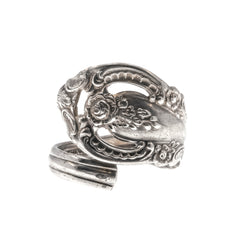 A Spoon Full Of Sugar - Vintage Silver Plate Community Spoon Ring (VR545)
$125.00
A Spoon Full Of Sugar - Vintage Silver Plate Community Spoon Ring (VR545)
$125.00
-
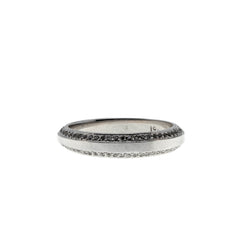 A Timeless Classic - Vintage European 19K White Gold Natural Diamond Wedding Band Ring (VR1045)
$2,195.00
A Timeless Classic - Vintage European 19K White Gold Natural Diamond Wedding Band Ring (VR1045)
$2,195.00
-
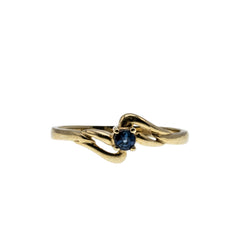 A Touch Of Blue - Vintage 10K Gold Natural Sapphire Bypass Swirl Ring (VR1036)
$395.00
A Touch Of Blue - Vintage 10K Gold Natural Sapphire Bypass Swirl Ring (VR1036)
$395.00