On This Day In 1907 - Edwardian English 18K Gold Natural Demantoid Green Garnet & Rose Cut Diamond Carved Ring (EDR108)
Rarities Antique Jewelry
On This Day In 1907 - Edwardian English 18K Gold Demantoid Green Garnet & Rose Cut Diamond Carved Ring. This exquisite ring is crafted from 18K gold, hallmarked 18 for 18K, Chester assay, a letter date 'G' for 1907, a makers mark, and inventory number 1759. The ring features 3 natural Demantoid green garnet gemstones (one cushion cut, and two brilliant cut), 4 natural rose cut diamonds, Edwardian era styling (1907), and quality craftsmanship. The gallery is expertly claw-set with beautiful vibrant green Demantoid green garnets, which are interspaced by glowing rose cut diamonds. The profile of the ring showcases wonderful deeply carved scrolls, and decorative shoulders. The band is smooth, and polished, which allows for a comfortable fit, and easy sizing. This Edwardian era ring is a rare example, beautifully crafted, and exhibits its full crisp English hallmarks.
Note: Contemporary appraisals do not reflect the value of antique jewelry. This ring should be insured for $3000. 00 (Tax Excluded) because of its rarity in the fact that the ring is set with rare Demantoid green garnets, and that the ring was made in Chester, England. The Chester Assay Office was closed in 1962, therefore less jewelry has been made in Chester.
History: Demantoid garnet is a rare green andradite garnet celebrated for its diamond like brilliance.
First Discovery: Miners found demantoid in the mid-19th century (around 1851–1853) in the alluvial deposits and serpentinized ophiolites of the Ural Mountains in Russia.
Initial Confusion: Miners and jewelers first mistook the vibrant green stones for emeralds or peridot.
Identification & Name: Finnish mineralogist Nils Gustaf Nordenskiöld properly identified it as a distinct garnet variety. He named it demantoid, derived from the Dutch/German word demant (diamond), because its dispersion exceeds even that of a diamond.
The "Emerald for Tsars": The gemstone became a favorite of the Russian Imperial family, nobility, and the Romanoff dynasty.
Carl Fabergé: Master jeweler Carl Fabergé prominently featured demantoids in his iconic imperial jeweled eggs and fine Edwardian/Art Nouveau jewelry.
Tiffany & Co.: In 1891, gemologist George F. Kunz purchased notable supplies of demantoid for Tiffany & Co., introducing it to Western high society.
The "Horsetail" Signature: Russian stones are famous for golden, radiating byssolite fibers known as "horsetail" inclusions, which collectors treat as a hallmark of Russian authenticity.
Decline: Production in the Urals slowed dramatically and essentially halted following the Russian Revolution of 1917.
New Global Sources: While Russian demantoids from the Ural Mountains remain the historical gold standard, significant new deposits were discovered in Namibia (such as the Green Dragon Mine in 1996), Italy, Iran, and Madagascar in the late 20th and early 21st centuries.
Characteristics of Non-Russian Stones: Namibian and Madagascan demantoids are often cleaner and larger than traditional Russian stones (which rarely exceed 2 carats), though they may lack the classic horsetail inclusions
The earliest diamonds were found in India in 4th century BC, although the youngest of these deposits were formed 900 million years ago. A majority of these early stones were transported along the network of trade routes that connected India and China, commonly known as the Silk Road.
The rose cut originated in the 1500's and was commonly used through the Georgian and Victorian eras. Like other antique diamond cuts, they were cut by hand and meant to dazzle under candlelight. Their large, wide facets performed exquisitely in low light conditions.
The rose cut is considered to be one of the oldest diamond cuts. Rose cut diamonds gathered popularity from their creation in the 1500s right through to the late 19th Century.
Today, they are seeing a renaissance and are highly sought-after.It can be challenging to find a rose cut that you'll love because they are so rare in the market. - Because the rose cut diamond is cut by hand, there will often be tiny imperfections or asymmetries to the facets.
Many are already aware of history behind the 'ring finger,' and with the romanticism of the 'Rose Cut', the cut became a symbol for love as the ring would be “wrapped around the part of the body that connected directly to the heart”
You cannot look at antique cut diamond jewelry factually with a recut formula in mind, its value is object driven. Antique cuts are a greater challenge in estimating weight once they have been mounted (especially if they are closed back). These antique cut diamonds are hand cut, which makes them so special . This is a rare find.
In 1953, GIA formally created its diamond grading system, known as the 4 C's. The 4 Cs of diamond quality are the universally recognized diamond grading system still to be used today. 1n 1955, GIA presented its first diamond grading reports, which became the hallmark of grading reports in the diamond industry. Before this time in antiquity clients did not care about diamond grading. It was based more so on the size of the diamonds ( according to budget) , style, and sentiment. This ring is a wonderful example of the Victorian era, just beautiful!
Gold was generally used for a couple thousand years solely to create things such as jewelry and idols for worship. This was until around 1500 BC when the ancient empire of Egypt, which benefited greatly from its gold-bearing region, Nubia, made gold the first official medium of exchange for international trade.
Measurements: Face of the Ring 16.00 mm x 5.00 mm
Stone Size: Demantoid Garnet (Cushion Cut) .45 Carats Round Brilliant .23 carats Total Demantoid Green Garnet Carat Weight: .68 Carats Clarity SI Strong Vibrant Colour. Diamonds (Rose Cut) .04 Carats Clarity I1 Colour G/H with a very good cut.
Weight: 2.88 grams
Ring Size: 6 1/4
Condition: Excellent Note : Some age related wear to gemstones seen under magnification. To be expected in a ring that is over 100 years old.
Origin: England, Chester
Date: 1907 (Letter Date 'G' )
You may also like...
-
 A Day In 1919 - Edwardian 14K Gold Natural Amethyst & Pearl 'Forget Me Knot' Engraved Filigree Ring (EDR105)
$2,995.00
-
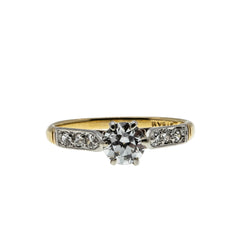 Antique Proposal - Edwardian Signed 'Ryrie' 18K Gold Natural Old European Cut Diamond Engagement Ring (EDR093)
$3,995.00
-
 Birks - Edwardian Sterling Silver Paste Filigree Pin Brooch (EDBR004)
$125.00
-
 Downton Girl - Edwardian (Post) 1917 Sterling Silver Paste Buckle Bracelet (EDB002)
$395.00
-
 Edwardian Beauty - Edwardian English Signed Hand-Carved Conch Shell Cameo Portrait Ring (EDR074)
$1,695.00
-
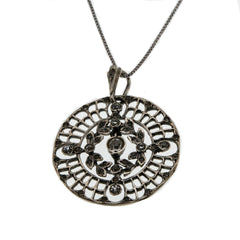 Edwardian Delicacy - Edwardian Sterling Silver Paste Gemstone Filigree Pendant & Chain (EDP026)
$395.00