Recently Sold (VN212)
Rarities Antique Jewelry
Sorry, this item is Sold
Portrait Of a Lady - Vintage Gold Plated Cameo Black Velvet Choker Necklace. This lovely choker is crafted from gold plate over metal. The choker features a cameo (resin), and vintage styling. This choker is comprised of a beautiful ornate brooch, which is set with a peach and cream coloured cameo. The brooch is pinned onto a black velvet choker, which is adjustable so it can be worn to your desired size. The brooch is removable, which allows the cameo to be worn as a brooch or as a choker. Truly a wonderful vintage piece, which will bring a touch of elegance and charm to any outfit.
History: It is known that cameos have existed since Sumerian period (c. 3100 BC) to the decline of Roman civilization, the Renaissance, and the Neoclassical period in the 18th century. In contrast to the intaglios, which were used as seals.
Cameos are usually made of gemstones such as agate, onyx, or sardonyx, with two layers of contrasting colours with figures carved into one of the layers and projected over the other. Creating a multi-dimensional artwork. Cameos can also be made out of shell, coral, stone lava, glass, or resin.
The technology behind gold plated jewelry is credited to Italian chemist Luigi Brugnatelli. In 1805, he discovered the process for electroplating. It was quickly adopted for jewelry styles, with many Victorian jewelry pieces using gold plating.
Velvet's history is a rich tapestry woven from ancient origins in the East, specifically in China and Egypt, where pile weaves were first developed. By the 13th century, European centers like Lucca, Genoa, and Florence had mastered the art of velvet weaving, making it a symbol of status and luxury.The Industrial Revolution further propelled velvet into the mainstream, making it more accessible and diverse in its applications.
Whether it’s a Victorian lady of means or a 1990s punk rocker, chokers have been a prominent feature of women’s fashion for a long time. The history of chokers stretches back beyond the 1990s, to at least 2500 BC. Sumerian jewellers were crafting chokers thousands of years before they became a part of the youth sub-culture. Furthermore, almost all of the earliest civilizations on the planet wore chokers as a part of their cultural identity. Ancient Egyptians, Sumerians, and Minoans have all left evidence of their use of chokers in their respective societies.
The chokers worn by such people were usually made mostly out of gold, with some examples discovered featuring lapis lazuli – a very commonly used stone in ancient civilizations. From what is known today, these civilizations held strong beliefs that necklaces such as these could provide protection as well as powers. The initial use of chokers was for this purpose, as well as being used as the same accessory that it is today.
Although it is confirmed by archaeologists that chokers were worn in some form by various ancient civilizations, chokers have only been comparable to today’s chokers for a few hundred years.
A prominent figure we know of who wore chokers was Anne Boleyn. In the most famous portrait of her, she is depicted wearing a pearl choker featuring a pendant in the shape of a ‘B’. As Anne Boleyn lived in the early 1500s, it is possible to presume that chokers have had some relevance to royalty and fashion for many centuries. Moving forward several centuries, chokers had a divisive reputation in the 1800s.
Royals had immense influence over popular styles, and chokers were very fashionable among the upper classes in the Victorian period because of their popularity among the royal family. In the late 19th century, chokers were commonly worn by ballerinas, acting as a part of their costuming. However, chokers were also heavily associated with prostitutes at this time. The difference in styles was clear, as upper classes wore elaborate chokers made with gemstones, pearls, and precious metals, and prostitutes wore simple ribbon of red or black.
At the end of the 20th century, the popularity of chokers continued through the influence of Queen Alexandra. The queen frequently wore chokers of various styles in order to cover a scar on her neck. Alexandra’s influence meant that the popularity of chokers – particularly pearl chokers – continued through the 1910s.
In the 1920s and 1940s, chokers were popular as a somewhat rebellious accessory. Young women in these decades wore chokers under the name ‘colliers de chien’, or ‘dog collars’. These chokers were made with finer materials than those of the Victorian period, such as lace and velvet. These chokers were limited to socially elite young women, as the finest examples were custom made to fit the neck, making them very expensive items.
The hippie culture and musical movement of the 1960s and 1970s revived the choker necklace style. The choker became a unisex accessory that was particularly popular amongst men at the time. Iconic rockstars such as mick jagger and Jimi Hendrix could be seen wearing chokers throughout performances, beaded or studded or even embellished with feather details.
Towards the end of the 20th century, in the early 1990s, chokers once again rose to prominence. As in the 1940s, these chokers were worn as an act of rebellion. These chokers were not made from the same luxury materials of their earlier counterparts, many were made from an elasticated plastic that enabled mass production. Although chokers faded in fashion towards the turn of the century, they once again became popular in the 2010s. Today, chokers are not as heavily linked to rebellious sub-cultures. They are no longer linked to royalty, and are not often considered to be glamorous unless made from precious gemstones like pearls and diamonds.
Numerous jewellery styles are routinely in and out of fashion. Chokers may fade out of vogue temporarily, but they always rise to the peak of popularity once more.
Measurements: Choker 11 1/2 - 14" (Adjustable)
Stone Size: Cameo (Resin) 13.00 mm x 6.00 mm
Weight: 7.80 grams
Condition: Very Good Note: Some age related gold plate wear to clasp and extender. This does not take away from the beauty of the piece what-so-ever.
Origin: America
Date: Circa 1960
You may also like...
-
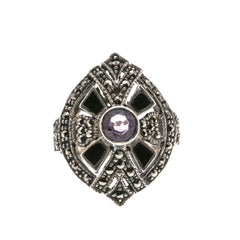 Art Deco Geometry- Vintage Sterling Silver Amethyst, Onyx & Marcasite Ring
Sold
Art Deco Geometry- Vintage Sterling Silver Amethyst, Onyx & Marcasite Ring
Sold
-
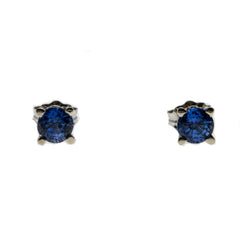 Brilliant Skies - Estate 14K White Gold Natural Blue Sapphire Stud Earrings (EE213)
Sold
Brilliant Skies - Estate 14K White Gold Natural Blue Sapphire Stud Earrings (EE213)
Sold
-
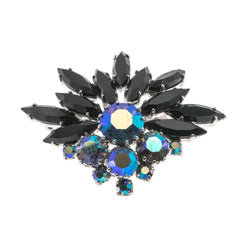 Contrasting Adornment - Vintage Silver Tone Aurora Borealis Crystal Brooch (VBR054)
Sold
Contrasting Adornment - Vintage Silver Tone Aurora Borealis Crystal Brooch (VBR054)
Sold
-
 Date Night - Vintage Retro Sterling Silver Intricate Bracelet (VB121)
Sold
Date Night - Vintage Retro Sterling Silver Intricate Bracelet (VB121)
Sold
-
 Glowing Nature - Estate Sterling Silver Freshwater Pearl CZ Ring (ER229)
Sold
Glowing Nature - Estate Sterling Silver Freshwater Pearl CZ Ring (ER229)
Sold
-
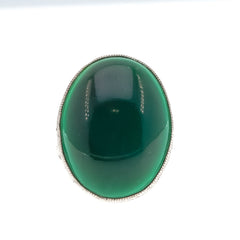 Rainforest - Art Deco Sterling Silver Chrysoprase Ring (ADR210)
Sold
Rainforest - Art Deco Sterling Silver Chrysoprase Ring (ADR210)
Sold