Starry Nights - Edwardian English Platinum 18K White Gold Natural Blue Sapphire & Old European Cut Diamond Dangly Earrings (EDE016)
Rarities Antique Jewelry
Starry Nights - Edwardian English Platinum 18K White Gold Natural Blue Sapphire & Old European Cut Diamond Dangly Earrings. These exquisite earrings are crafted from platinum, and 18K white gold ear wires, tested and confirmed. These earrings feature two natural oval cut faceted blue sapphires, 20 natural Old European cut diamonds, Edwardian era styling, and quality craftsmanship. The galleries on these earrings are expertly claw-set with beautiful deep blue sapphires, displaying bluish/violet hues. The precious sapphires are surrounded by a sparkling diamond surround, which add contrast, and beauty the earrings. The gallery exhibits a delicate milgrain decoration (a characteristic of Edwardian, and Art Deco era jewelry) on the outer frame of the cluster and the bezel-set diamonds. The entire setting is made of platinum, whilst the earring wires are crafted in white gold. The earrings are for pierced ears, featuring easy to wear ear wire hooks. These Edwardian era earrings are a rare find, which look elegant and classic when worn.
Comments: A much coveted design, which are versatile and easy to wear with todays fashion. Very desirable, and high quality.
Note: Appraisal included with the earrings. Contemporary appraisals do-not reflect the value of antique jewelry.
History: The celestial blue color of this gemstone symbolized heaven and attracted divine favor and wise judgment. Greeks wore sapphire for guidance when seeking answers from the oracle. Buddhists believed that it brought spiritual enlightenment, and Hindus used it during worship.
The earliest diamonds were found in India in 4th century BC, although the youngest of these deposits were formed 900 million years ago. A majority of these early stones were transported along the network of trade routes that connected India and China, commonly known as the Silk Road.
The Old European Cut, a historic diamond cut, evolved in Europe and gained popularity between 1890 and 1930, serving as a precursor to the modern Round Brilliant cut. It's characterized by its round shape, high crown, and a small table, offering a unique charm due to being hand-cut. This cut was especially popular during the Edwardian and Art Deco periods.
In 1953, GIA formally created its diamond grading system, known as the 4 C's. The 4 Cs of diamond quality are the universally recognized diamond grading system still to be used today. 1n 1955, GIA presented its first diamond grading reports, which became the hallmark of grading reports in the diamond industry. Before this time in antiquity clients did not care about diamond grading. It was based more so on the size of the diamonds ( according to budget) , style, and sentiment. This ring is a wonderful rare example of the Art Deco era, just beautiful!
The name is derived from the Spanish platina, meaning "silver." Platinum was discovered in South America independently by Antonio de Ulloa in 1735 and by N. Wood in 1741, but it had been in use by pre-Columbian natives.
Platinum is one of the rarest metals in the world. It is more expensive than gold because only 160 tons of platinum are mined annually, as apposed to 1500 tons of gold. Also platinum is more dense than gold, so the same ring will weigh significantly more in platinum than gold (precious metals are priced by weight).
Gold was generally used for a couple thousand years solely to create things such as jewelry and idols for worship. This was until around 1500 BC when the ancient empire of Egypt, which benefited greatly from its gold-bearing region, Nubia, made gold the first official medium of exchange for international trade.
White gold has been around since the turn of the 19th century, but it wasn't until the 1920s when it really started gaining popularity. At the time, platinum had been the preferred precious metal for jewellery. But it quickly became scarce as World War II raged on, and countries began to stockpile it for military use.
The Edwardian era corresponds to the reign of King Edward VII in Great Britain, whose short-lived governance (1901-1910) followed Victoria's long reign and preceded the modern House of Windsor in England. The "Edwardian" style broadly encompasses the years of 1901 through to 1919.
Measurements: Earrings (Including the ear wire) 29.00 mm x 12.00 mm
Stone Size: Sapphire 1.60 carats Diamonds (Old European Cut) 2.56 carats Clarity SI Colour G/H
Weight: 4.90 grams
Condition: Excellent
Origin: England Provenance: Scotland
Date: Circa 1910
You may also like...
-
 A Touch Of Green - Vintage German Kordes & Lichtenfels Rolled Gold Kite Shaped Emerald Green Glass French Lever back Dangly Earrings (VE564)
$145.00
-
 A Touch Of Pink - Vintage Signed 'JAY FLEX' Rhodium, Sterling Silver Austrian Swarovski Crystal Rhinestone Screw-Back Earrings (VE437)
$195.00
-
 AB Sparklers - Vintage Signed 'Coro' Rhodium Plated Austrian Swarovski Aurora Borealis Crystal Clip-On Dangly Earrings (VE453)
$125.00
-
 Age Of Elegance - Vintage Rhodium Plated Crystal Rhinestone Dangly Earrings (VE411)
$95.00
-
 Amethyst Allure - Vintage 14K Gold Natural Amethyst & Seed Pearl Dangly Earrings (VE487)
$7,495.00
-
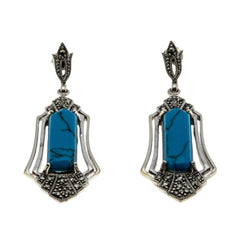 Art Deco Revival - Vintage Sterling Silver Turquoise & Marcasite Dangly Earrings (VE478)
$295.00