Recently Sold (ADR259)
Rarities Antique Jewelry
Sorry, this item is Sold
Don't Hold Back - Art Deco Platinum 'Old European Cut' Diamond Ring. This stunning ring is crafted from platinum, hallmarked PL for platinum. The ring features 3 large natural Old European cut diamonds, 14 smaller natural Old European cut diamonds, Art Deco era styling, and quality craftsmanship. The gallery on this ring is set with a vertical line of sparkling high quality diamonds, which is enhanced by geometric lines of smaller sparkling diamonds. The beautiful diamonds are set in platinum, and seems to wrap around the finger beautifully, which makes the ring extremely comfortable to wear. The band is smooth and polished, which allows for a comfortable fit and easy sizing. This Art Deco era ring is magnificent, and high quality. It would make a unique engagement ring, or gift for that special someone.
Comments: Beautiful design, and set with high quality diamonds.
Note: Appraisal included with the ring. Contemporary appraisals do not reflect the value of antique Jewelry.
History: The earliest diamonds were found in India in 4th century BC, although the youngest of these deposits were formed 900 million years ago. A majority of these early stones were transported along the network of trade routes that connected India and China, commonly known as the Silk Road.
The old European cut diamond became very popular around the late 1800s and is the predecessor of today's modern round brilliant cut. This antique cut has once again become a favorite due to the features of its cutting style and the fact that no two stones will ever be cut exactly alike.
Old European cut diamonds are cut in a style developed in Europe and popular from 1890 to 1930. If you find an antique ring with a round diamond from this period, it very likely features an old European cut, often abbreviated as "OEC."
Earlier diamonds typically received what is known as an "old mine cut," while later ones were cut as the well-known modern round brilliant.
Machine cutting wasn't available when old European-cut diamonds were popular. Each one was cut by hand. While you might think this means superior craftsmanship, it really just means that each one is unique.
While the old European cut was once the most popular diamond cut, its heyday is long past. The age of these diamonds makes them antiques. Of course, this gives them an allure that modern diamonds won't have.
There simply aren't very many of them, so few appear on the market at any given time.
Most old European-cut diamonds were cut to retain more weight, rather than optimize appearance. Because of the shape of rough diamonds, the end result was a deep cut with a high crown and small table. These old diamonds also often had a flat facet instead of a tip at the culet. This not only protected the bottom from chipping but also gave them a distinctive look. You can see the culet as a circle in the middle of the table.
The higher depth and steeper crown angles allow these diamonds to show off more fire. This effect is similar to a prism creating rainbows from sunlight. As light moves through the diamond, it splits into its component colors, each curving a different amount. The colors then reflect back to your eye. Since the light travels farther in a deeper diamond, you get more fire. However, this greater depth also means that there's more light leakage in an old European cut. These diamonds simply won't look as bright as modern round brilliants. They will show less white light.
There's something perfectly-imperfect about every old Euro cut. Their hand-cut character makes each diamond one-of-a-kind. Another upside to old European cuts? They're always an ethical choice.
The metal was used by pre-Columbian Indigenous but platinum was "rediscovered" in South America by Ulloa in 1735 and by Wood in 1741. In 1822 plenty of platinum was discovered in the Ural Mountains in Russia. alchemy is an ancient pursuit concerned with, for instance, the transformation of other metals into gold.
Over gold, platinum has earned its rank for a number of reasons. For starters, gold is far more abundant in the earth's crust, making platinum rarer. Whilst 1,500 tons of gold are mined annually, only 160 tons of platinum are extracted.
Art Deco was an international decorative style than ran from 1919 to 1939.
Art Deco is known for showcasing a bold geometric forms, sleek and elongated figures, classical influences, modern materials, and high-quality craftsmanship are all hallmarks of the Art Deco style.
Measurements: Face of the ring 19.00 mm x 12.00 mm
Stone Size: Diamonds (Old European Cut) 2.11 Carats Clarity VVS 2 - VS1 Colour GH and G-J (smaller diamonds)
Weight: 6.19 grams
Ring Size: 6 3/4
Condition: Excellent Note: Extraordinary condition considering the age of the ring.
Origin: Europe
Date: Circa 1920
You may also like...
-
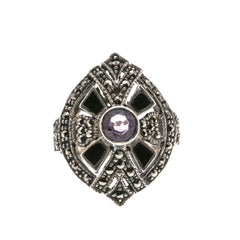 Art Deco Geometry- Vintage Sterling Silver Amethyst, Onyx & Marcasite Ring
Sold
Art Deco Geometry- Vintage Sterling Silver Amethyst, Onyx & Marcasite Ring
Sold
-
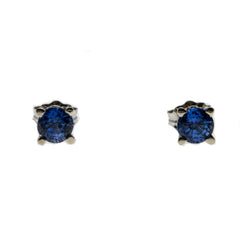 Brilliant Skies - Estate 14K White Gold Natural Blue Sapphire Stud Earrings (EE213)
Sold
Brilliant Skies - Estate 14K White Gold Natural Blue Sapphire Stud Earrings (EE213)
Sold
-
 Contrasting Adornment - Vintage Silver Tone Aurora Borealis Crystal Brooch (VBR054)
Sold
Contrasting Adornment - Vintage Silver Tone Aurora Borealis Crystal Brooch (VBR054)
Sold
-
 Date Night - Vintage Retro Sterling Silver Intricate Bracelet (VB121)
Sold
Date Night - Vintage Retro Sterling Silver Intricate Bracelet (VB121)
Sold
-
 Glowing Nature - Estate Sterling Silver Freshwater Pearl CZ Ring (ER229)
Sold
Glowing Nature - Estate Sterling Silver Freshwater Pearl CZ Ring (ER229)
Sold
-
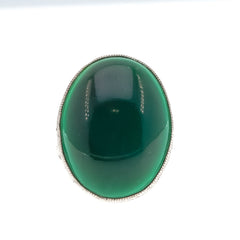 Rainforest - Art Deco Sterling Silver Chrysoprase Ring (ADR210)
Sold
Rainforest - Art Deco Sterling Silver Chrysoprase Ring (ADR210)
Sold