Recently Sold (EDR086)
Rarities Antique Jewelry
Sorry, this item is Sold
Forget-Me-Knot & Lace - Edwardian 14K White Gold Natural 'Old European Cut' Diamond Cobalt Blue Enamel Filigree Shield Ring. This unique ring is crafted from 14K white gold, tested. The ring features one 'Old European Cut' diamond, Edwardian era styling, and quality craftsmanship. The gallery on this ring is made in the form of a shield, which exhibits exquisite filigree work, cobalt blue enamelled forget-me-knots (the flowers are a characteristic of Edwardian jewelry), and a sparkling antique cut diamond. The band is smooth and polished, which allows for a comfortable fit and easy sizing. These Edwardian era shield rings are highly collectible, and unique...truly a wonderful addition to any antique jewelry collection.
Comments: A number of this shield rings were created once the stick pin became out of favour. Each one unique, and beautiful when worn as a ring on the finger. This particular example is unique because of the attractive cobalt blue enamel forget-me-knot flowers.
Note: Contemporary appraisals do not reflect the value of antique jewelry . It is recommended that this ring should be insured at $1200.00 CD (Tax Excluded)
History: The earliest diamonds were found in India in 4th century BC, although the youngest of these deposits were formed 900 million years ago. A majority of these early stones were transported along the network of trade routes that connected India and China, commonly known as the Silk Road.
The Old European Cut, a historic diamond cut, evolved in Europe and gained popularity between 1890 and 1930, serving as a precursor to the modern Round Brilliant cut. It's characterized by its round shape, high crown, and a small table, offering a unique charm due to being hand-cut. This cut was especially popular during the Edwardian and Art Deco periods.
In 1953, GIA formally created its diamond grading system, known as the 4 C's. The 4 Cs of diamond quality are the universally recognized diamond grading system still to be used today. 1n 1955, GIA presented its first diamond grading reports, which became the hallmark of grading reports in the diamond industry. Before this time in antiquity clients did not care about diamond grading. It was based more so on the size of the diamonds (according to budget) , style, and sentiment. This ring is a wonderful example of the Art Deco era, just beautiful!
Enamel jewelry, with its origins in ancient civilizations like Egypt and Greece boasts a rich history, evolving through the Byzantine Empire, Renaissance, and into modern times, with techniques like cloisonné and champlevé shaping its artistic expression.
Gold was generally used for a couple thousand years solely to create things such as jewelry and idols for worship. This was until around 1500 BC when the ancient empire of Egypt, which benefited greatly from its gold-bearing region, Nubia, made gold the first official medium of exchange for international trade.
Although the origin of white color gold dates back to 1710, where it was discovered by two alchemists in Germany, it wasn't used widely until much later. White gold as we know it today was really popularised in the 1920s. Although it might seem strange, this luxury material came to popularity in wartime.
The Edwardian era corresponds to the reign of King Edward VII in Great Britain, whose short-lived governance (1901-1910) followed Victoria's long reign and preceded the modern House of Windsor in England. The "Edwardian" style broadly encompasses the years of 1901 through to 1919.
Measurements: Face of the Ring 16.00 mm x 11.50 mm
Stone Size: Diamond (Old European Cut) .05 carats
Weight: 1.60 grams
Ring Size: 6 1/2
Condition: Excellent
Origin: America
Date: Circa 1910
You may also like...
-
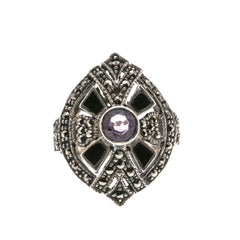 Art Deco Geometry- Vintage Sterling Silver Amethyst, Onyx & Marcasite Ring
Sold
Art Deco Geometry- Vintage Sterling Silver Amethyst, Onyx & Marcasite Ring
Sold
-
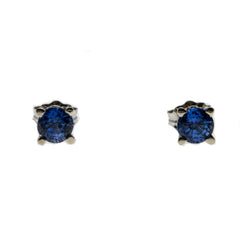 Brilliant Skies - Estate 14K White Gold Natural Blue Sapphire Stud Earrings (EE213)
Sold
Brilliant Skies - Estate 14K White Gold Natural Blue Sapphire Stud Earrings (EE213)
Sold
-
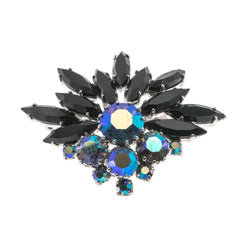 Contrasting Adornment - Vintage Silver Tone Aurora Borealis Crystal Brooch (VBR054)
Sold
Contrasting Adornment - Vintage Silver Tone Aurora Borealis Crystal Brooch (VBR054)
Sold
-
 Date Night - Vintage Retro Sterling Silver Intricate Bracelet (VB121)
Sold
Date Night - Vintage Retro Sterling Silver Intricate Bracelet (VB121)
Sold
-
 Glowing Nature - Estate Sterling Silver Freshwater Pearl CZ Ring (ER229)
Sold
Glowing Nature - Estate Sterling Silver Freshwater Pearl CZ Ring (ER229)
Sold
-
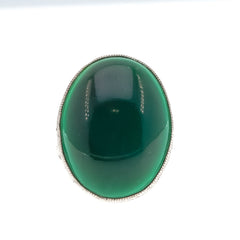 Rainforest - Art Deco Sterling Silver Chrysoprase Ring (ADR210)
Sold
Rainforest - Art Deco Sterling Silver Chrysoprase Ring (ADR210)
Sold