Recently Sold (ADR295)
Rarities Antique Jewelry
Sorry, this item is Sold
Blue Aura - Art Deco Platinum Natural Transitional Cut, Rose Cut Diamond & French Cut Sapphire Target Ring. This exquisite ring is crafted from solid platinum, tests for platinum, and confirmed with GIA appraisal. Featuring one natural transitional cut diamond, 6 natural rose cut diamonds, 19 natural French cut blue sapphires, Art Deco era styling and quality craftsmanship. The face of this beautiful ring is expertly bezel set with a sparking traditional cut diamond surrounded by channel set vibrant blue sapphires. The bezel is round shaped and features delicate milgrain detail. The shoulders of the ring have a gentle taper and are adorned with glowing rose cut diamonds. The gallery is very pretty, displaying wonderful pierced open-work. The shank is dainty, however still substantial and sturdy for everyday wear. This Art Deco era ring would make a perfect unique engagement ring, gift or addition to any fine jewelry collection.
Note: Appraisal included with the ring. Contemporary appraisals do not reflect the value of antique jewelry.
History: The earliest diamonds were found in India in 4th century BC, although the youngest of these deposits were formed 900 million years ago. A majority of these early stones were transported along the network of trade routes that connected India and China, commonly known as the Silk Road.
Transitional cut diamonds (circa 1920s-1940s) are a rare vintage diamond type that bridged the gap between old-world hand-cutting (Old European Cut) and modern machine-precision cutting. Developed largely by American cutters using early mechanized tools, they feature a smaller culet, higher crown, and better symmetry than predecessors, marking a move toward maximized brilliance and modern standards.
The rose cut originated in the 1500s and was commonly used through the Georgian and Victorian eras. Like other antique cut diamond cuts, they were cut by hand and meant to glow under candlelight. The shape of the rough diamond influences the shape the diamond will be cut into.
In 1953, GIA formally created its diamond grading system, known as the 4 C's. The 4 Cs of diamond quality are the universally recognized diamond grading system still to be used today. 1n 1955, GIA presented its first diamond grading reports, which became the hallmark of grading reports in the diamond industry. Before this time in antiquity clients did not care about diamond grading. It was based more-so on the size of the diamonds ( according to budget), rarity, style, desirability, and sentiment.
The celestial blue color of this gemstone symbolized heaven and attracted divine favor and wise judgment. Greeks wore sapphire for guidance when seeking answers from the oracle. Buddhists believed that it brought spiritual enlightenment, and Hindus used it during worship.
The name is derived from the Spanish platina, meaning "silver." Platinum was discovered in South America independently by Antonio de Ulloa in 1735 and by N. Wood in 1741, but it had been in use by pre-Columbian natives.
Platinum is one of the rarest metals in the world. It is more expensive than gold because only 160 tons of platinum are mined annually, as apposed to 1500 tons of gold. Also platinum is more dense than gold, so the same ring will weigh significantly more in platinum than gold (precious metals are priced by weight).
Target rings, characterized by concentric circles surrounding a central gemstone, emerged during the Edwardian (late 19th/early 20th century) and Belle Époque eras as a romantic, symbolic design. They flourished during the Art Deco movement for their geometric symmetry, featuring contrasting stones like ruby/sapphire halos around diamonds
The Art Deco jewelry period circa 1919-1939 emerged post-WWI, emphasizing bold geometric shapes, symmetry, and modernity in contrast to Art Nouveau’s fluid lines. Defined by the "Roaring '20s" style, it featured platinum, diamonds, onyx, and bright gemstones, often inspired by Egyptian and Asian design.
Measurements: Face of the ring 9.00 mm x 9.00 mm
Stone Size: Diamond (Transitional Cut) .64 carats Rose Cut Diamonds .06 carats Sapphires .19 carats Total carat weight: .89 carats
Weight: 2.31 grams
Ring Size: 6 3/4
Condition: Excellent
Origin: America
Date: Circa 1920
You may also like...
-
 An Heirloom Proposal - Art Deco Platinum Natural 'Old European Cut' Diamond Solitaire Engraved Engagement Ring (ADR284)
$4,995.00
An Heirloom Proposal - Art Deco Platinum Natural 'Old European Cut' Diamond Solitaire Engraved Engagement Ring (ADR284)
$4,995.00
-
 Art Deco Flapper Sautoir Ruby Red Czech Crystal Necklace
$175.00
Art Deco Flapper Sautoir Ruby Red Czech Crystal Necklace
$175.00
-
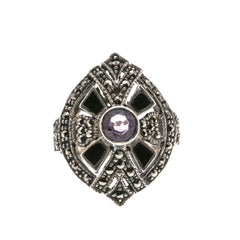 Art Deco Geometry- Vintage Sterling Silver Amethyst, Onyx & Marcasite Ring
Sold
Art Deco Geometry- Vintage Sterling Silver Amethyst, Onyx & Marcasite Ring
Sold
-
 Art Deco Revival - Vintage Rhodium Plated Crystal Rhinestone Ring (ER276)
$65.00
Art Deco Revival - Vintage Rhodium Plated Crystal Rhinestone Ring (ER276)
$65.00
-
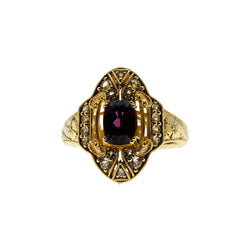 Art Deco Revival - Vintage Signed 'Generations 1912' Gold Plated Sterling Silver Natural Rhodolite Garnet & White Topaz Ring (VR1147)
$595.00
Art Deco Revival - Vintage Signed 'Generations 1912' Gold Plated Sterling Silver Natural Rhodolite Garnet & White Topaz Ring (VR1147)
$595.00
-
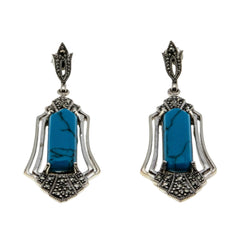 Art Deco Revival - Vintage Sterling Silver Turquoise & Marcasite Dangly Earrings (VE478)
$295.00
Art Deco Revival - Vintage Sterling Silver Turquoise & Marcasite Dangly Earrings (VE478)
$295.00