Deco Artistry - Art Deco Platinum Natural 'Old European Cut' Diamond & Sapphire Shield Ring (ADR300)
Rarities Antique Jewelry
Deco Artistry - Art Deco Platinum Natural 'Old European Cut' Diamond & Sapphire Shield Ring. This exquisite ring is crafted from platinum, tests platinum, tested and confirmed. Featuring 17 natural 'Old European Cut' diamonds, 6 custom cut synthetic sapphires,(a characteristic of Edwardian and Art Deco era jewelry) Art Deco era styling, and high quality craftsmanship. There a 3 expertly claw-set glowing diamonds housed in an octagon shaped bezel setting, flanked by blue sapphires sapphires on each side, which are surrounded by a sea of old-cut diamonds throughout the ring. The diamonds are bright, white and sparkling, whilst the sapphires are a beautiful shade of indigo blue. The shoulders of the ring have a lovely 'hand-chased' detail , adding even more beauty to the piece. The shank is solid, smooth, and polished, which allows for easy sizing. This Art Deco era piece is very special, truly a ring to be enjoyed and treasured for many years to come.
Comments: Stunning design, and wonderfully preserved. A true heirloom piece.
Note: Appraisal included with the ring. Contemporary appraisals do not reflect the value of antique jewelry.
History : The earliest diamonds were found in India in 4th century BC, although the youngest of these deposits were formed 900 million years ago. A majority of these early stones were transported along the network of trade routes that connected India and China, commonly known as the Silk Road.
The Old European Cut, a historic diamond cut, evolved in Europe and gained popularity between 1890 and 1930, serving as a precursor to the modern Round Brilliant cut. It's characterized by its round shape, high crown, and a small table, offering a unique charm due to being hand-cut. This cut was especially popular during the Edwardian and Art Deco periods.
In 1953, GIA formally created its diamond grading system, known as the 4 C's. The 4 Cs of diamond quality are the universally recognized diamond grading system still to be used today. 1n 1955, GIA presented its first diamond grading reports, which became the hallmark of grading reports in the diamond industry. Before this time in antiquity clients did not care about diamond grading. It was based more so on the size of the diamonds ( according to budget) , style, and sentiment. This ring is a wonderful rare example of the Art Deco era, just beautiful!
The celestial blue color of this gemstone symbolized heaven and attracted divine favor and wise judgment. Greeks wore sapphire for guidance when seeking answers from the oracle. Buddhists believed that it brought spiritual enlightenment, and Hindus used it during worship.
Synthetic gem crystals have been manufactured since the late 1800s, and their production is often marked by a need for them in industrial applications outside of the jewelry industry. The first success was in producing synthetic ruby of faceting quality.
The first synthetic sapphire was successfully made in 1873 by the flux method. This was followed shortly by the flame fusion method in 1902. Needless to say, at the turn of the century synthetic gemstones were quickly rising in popularity.
Synthetic sapphires were prized in high-end Art Deco jewelry for their flawless clarity, perfect colour uniformity, and ability to be cut into precise geometric shapes. Unlike natural stones, which often have color zoning and inclusions, these lab-created gems were viewed as a modern, high-tech improvement perfectly suited to the era’s demand for sharp, symmetrical designs.
The name is derived from the Spanish platina, meaning "silver." Platinum was discovered in South America independently by Antonio de Ulloa in 1735 and by N. Wood in 1741, but it had been in use by pre-Columbian natives.
Platinum is one of the rarest metals in the world. It is more expensive than gold because only 160 tons of platinum are mined annually, as apposed to 1500 tons of gold. Also platinum is more dense than gold, so the same ring will weigh significantly more in platinum than gold (precious metals are priced by weight).
The Art Deco jewelry period flourished from the 1920s to the 1930s, characterized by bold geometric shapes, strong symmetry, and streamlined forms, a stark contrast to the softer, naturalistic Art Nouveau style that preceded it. Key influences included Cubism, the discovery of Tutankhamun's tomb, and industrial advancements, while popular materials featured platinum, white gold, diamonds, and colorful gemstones like onyx, emeralds, and rubies.
Measurements: Face of Ring 25.00 mm x 20.50 mm
Stone Size: Diamond (Old European Cut) .90 carats Sapphires: .06 carats
Weight: 5.38 grams
Ring Size: 7
Condition: Excellent
Origin: America
Date: Circa 1920
You may also like...
-
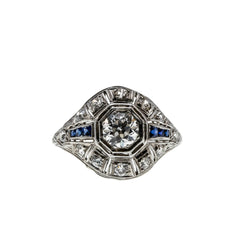 1920s Rarity - Art Deco Platinum Natural Old European Cut Diamond & Sapphire Ring (ADR301)
$6,495.00
1920s Rarity - Art Deco Platinum Natural Old European Cut Diamond & Sapphire Ring (ADR301)
$6,495.00
-
 An Heirloom Proposal - Art Deco Platinum Natural 'Old European Cut' Diamond Solitaire Engraved Engagement Ring (ADR284)
$4,995.00
An Heirloom Proposal - Art Deco Platinum Natural 'Old European Cut' Diamond Solitaire Engraved Engagement Ring (ADR284)
$4,995.00
-
 Art Deco Flapper Sautoir Ruby Red Czech Crystal Necklace
$175.00
Art Deco Flapper Sautoir Ruby Red Czech Crystal Necklace
$175.00
-
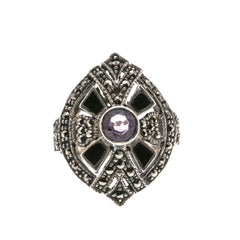 Art Deco Geometry- Vintage Sterling Silver Amethyst, Onyx & Marcasite Ring
Sold
Art Deco Geometry- Vintage Sterling Silver Amethyst, Onyx & Marcasite Ring
Sold
-
 Art Deco Revival - Vintage Rhodium Plated Crystal Rhinestone Ring (ER276)
$65.00
Art Deco Revival - Vintage Rhodium Plated Crystal Rhinestone Ring (ER276)
$65.00
-
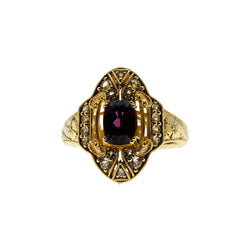 Art Deco Revival - Vintage Signed 'Generations 1912' Gold Plated Sterling Silver Natural Rhodolite Garnet & White Topaz Ring (VR1147)
$595.00
Art Deco Revival - Vintage Signed 'Generations 1912' Gold Plated Sterling Silver Natural Rhodolite Garnet & White Topaz Ring (VR1147)
$595.00