Go Baroque - Art Deco Spanish Sterling Silver Amethyst & Diamond Paste Chandelier Earrings (ADE042)
Rarities Antique Jewelry
Go Baroque - Art Deco Spanish Sterling Silver Amethyst & Diamond Paste Chandelier Earrings. These exquisite earrings are crafted from sterling silver, hallmarked 925 on the back of the surmounts, and tested. These earrings feature 2 marquise cut faceted paste gemstones, 26 rose cut paste gemstones, Art Deco era styling in the Spanish baroque style, and quality craftsmanship. These stunning earrings are for pierced ears, featuring a hinged locking mechanism, in perfect working order. The earrings are created in a girandole design (a characteristic seen in the 18th century) However these were created in the Art Deco period in the 18th century Spanish Baroque design. The earrings showcase wonderful open-work, and 3 drops, which are adorned by paste gemstones. They are solid, and substantial, yet not to heavy on the ear. These Art Deco earrings would make a perfect gift for that special someone, or a great addition to any antique jewelry collection.
Comments: Stunning design, and beautiful paste gemstones.
History: The use of glass in jewelry dates back to around the 1st century BCE when glassblowing was invented. This revolutionary technique allowed artisans to create more intricate and varied designs, leading to the proliferation of beautiful glass jewelry pieces.
Paste is a synonym for glass when used in the context of a gem material. Glass has been used as a gemstone imitation since ancient history for obvious reasons: it's transparent, can be colored in many ways and resembles all kinds of gemstones when polished.
While leaded glass has been used jewelry since at least the 1600s, Georges-Frédéric Strass, eventual Jeweler to the King of France, launched paste stones into Western fashion's mainstream in the 1720s. The origins of the term “paste” are debated, but the process and recipes are known.
By the 1900s, the Industrial Age, brought with it new technologies for manufacturing faux gems and edged out the artistry of the 18th century paste.
1930, when traditional Paste jewelery came to an end. This was due to Parisian Couture designers such as Coco Chanel and Elsa Schiaparelli ...
Silver's history is long. The first evidence of silver mining dates back to 3000 B.C., in Turkey and Greece, according to the RSC. Ancient people even figured out how to refine silver. They heated the silver ore and blew air over it, a process called cupellation.
The sterling alloy originated in continental Europe and was being used for commerce as early as the 12th century in the area that is now northern Germany. A piece of sterling silver dating from Henry II's reign was used as a standard in the Trial of the Pyx until it was deposited at the Royal Mint in 1843.
Flourishing between 1920 and 1935, Art Deco jewelry rejected Victorian curves for geometric precision, symmetry, and bold color contrasts. Driven by the Jazz Age, King Tut's tomb discovery, and Cubism, the era introduced platinum settings, newly invented diamond cuts (like baguette and Asscher), and vibrant gemstone accent.
Early Art Deco (1920-1935): Carried some delicate, lacy filigree elements from the preceding Edwardian period, but shifted heavily towards monochromatic white-on-white designs featuring diamonds and platinum.
Measurements: Earrings 60.00 mm x 20.00
Stone Size: Paste: Marquise 7.00 mm x 4.00 mm Round Paste Crystal: 1.50 mm each
Weight: 9.20 grams
Condition: Excellent Note: Wonderful aged patina.
Origin: Spain
Date: Circa 1920
You may also like...
-
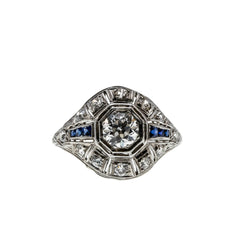 1920s Rarity - Art Deco Platinum Natural Old European Cut Diamond & Sapphire Ring (ADR301)
$6,495.00
1920s Rarity - Art Deco Platinum Natural Old European Cut Diamond & Sapphire Ring (ADR301)
$6,495.00
-
 An Heirloom Proposal - Art Deco Platinum Natural 'Old European Cut' Diamond Solitaire Engraved Engagement Ring (ADR284)
$4,995.00
An Heirloom Proposal - Art Deco Platinum Natural 'Old European Cut' Diamond Solitaire Engraved Engagement Ring (ADR284)
$4,995.00
-
 Art Deco Flapper Sautoir Ruby Red Czech Crystal Necklace
$175.00
Art Deco Flapper Sautoir Ruby Red Czech Crystal Necklace
$175.00
-
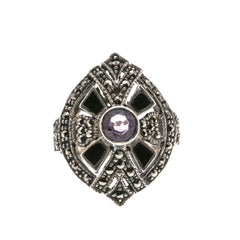 Art Deco Geometry- Vintage Sterling Silver Amethyst, Onyx & Marcasite Ring
Sold
Art Deco Geometry- Vintage Sterling Silver Amethyst, Onyx & Marcasite Ring
Sold
-
 Art Deco Revival - Vintage Rhodium Plated Crystal Rhinestone Ring (ER276)
$65.00
Art Deco Revival - Vintage Rhodium Plated Crystal Rhinestone Ring (ER276)
$65.00
-
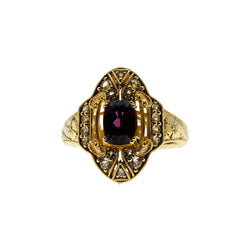 Art Deco Revival - Vintage Signed 'Generations 1912' Gold Plated Sterling Silver Natural Rhodolite Garnet & White Topaz Ring (VR1147)
$595.00
Art Deco Revival - Vintage Signed 'Generations 1912' Gold Plated Sterling Silver Natural Rhodolite Garnet & White Topaz Ring (VR1147)
$595.00