Kaleidoscope Of Colour - Vintage 14K Gold Natural Opal Filigree Pendant/Brooch (VP324)
Rarities Antique Jewelry
Kaleidoscope Of Colour - Vintage 14K Gold Natural Opal Filigree Pendant/Brooch. This exquisite Pendant/brooch is crafted from 14K yellow gold, tested, and confirmed. The pendant features one oval natural opal cabochon, 10 natural round opal cabochons, vintage era styling, and high quality craftsmanship. The gallery on this brooch is expertly hand-set with beautiful opals, which display a wonderful colour play in different light intensities. The precious opals are surrounded by a sea of filigree throughout the entire piece. Even the bale features filigree work. The unusual and fantastic feature on this piece is that the brooch is a 'three way', which means that it can be worn as a pendant, two different ways, and as a brooch (see hand-shots for the different ways that the brooch can be worn). There are two bales on this piece, one crafted with filigree decoration, and the other is a hidden bale, so the brooch can be worn horizontally, or vertically. The filigree bale folds over, so it is hidden when the piece is worn as a brooch. The pin on the back of the brooch locks into place with a rotary mechanism, which is in perfect working order. This brooch looks stunning when worn, and is shaped in such a way that the pendant has dimension. When worn the pendant looks like a locket. The pendant is accompanied by a 14K gold fill chain, however the piece also looks beautiful on a ribbon. This vintage era pendant/brooch would make a wonderful gift for that special someone or addition to any fine jewelry collection.
Note: Appraisal included with the pendant. Contemporary appraisals do not reflect the value of antique/vintage jewelry.
History: Archaeological evidence suggests that Opal was first mined in Virgin Valley, North America, over 10,000 years ago and used in artefacts in Kenya 6 thousand years ago. Additionally history also suggests that the Aztecs were mining opal in South and Central America around the same time.
Opal was first mined commercially at Listowel Downs in Queensland in 1875 and later at White Cliffs in NSW. Today, Coober Pedy (SA) is the main producer of white opal, though in recent years this field has expanded and all types of opals are found. Other centres in SA include Andamooka and Mintabe.
The stone is said to help stimulate originality and dynamic creativity, encouraging an interest in the arts and one's self-expression. Because the Precious Gemstone is so reflective with its play of color, it also symbolizes the expansion of the mind, growing not only creatively but with empathy as well.
Gold was generally used for a couple thousand years solely to create things such as jewelry and idols for worship. This was until around 1500 BC when the ancient empire of Egypt, which benefited greatly from its gold-bearing region, Nubia, made gold the first official medium of exchange for international trade.
Filigree is an ancient metalwork technique that shapes fine, twisted, or curled threads and tiny beads of precious metal—usually gold or silver—into delicate, lace-like patterns.The word comes from the Latin film (thread) and geranium (grain).
Mesopotamia & Egypt (c. 3000–2500 BCE): Early wirework and granulation emerged in ancient Mesopotamia (including the Royal Tombs of Ur) and Egypt.
Greek & Etruscan Mastery (6th–3rd century BCE): Goldsmiths refined fine wire soldering and granulation, and later incorporated gemstones such as garnets, pearls, and sapphires.
Roman & Byzantine Traditions: Rome spread filigree across trade routes, while Byzantine and early medieval European artisans (including Anglo-Saxon and Insular metalworkers) applied wirework to brooches, sword hilts, and religious objects.
Asia: Distinct traditions developed over centuries, including telkari in Turkey, tarakasi and Karimnagar silverwork in India, and Chinese filigree inlaid metal art (which peaked during the Ming and Qing dynasties).
Portugal & Iberia: Reaching Iberia via ancient trade and Arab influence, filigree became a hallmark of northern Portuguese goldsmithing, expanding rapidly in the 17th and 18th centuries under royal, clerical, and Baroque patronage.
Edwardian & Art Deco Eras: In the early 20th century, lighter platinum and white gold settings paired with white diamonds and geometric motifs reshaped filigree styles. Die-striking also introduced faster, higher-density production alongside traditional hand soldering.
Contemporary Craft: Hand-soldered filigree remains labor-intensive and unsuited to mass production, while modern makers also blend traditional wirework with contemporary design and digital fabrication tools.
Measurements: Pendant/Brooch (Including the bale) 49.50 mm x 27.50 mm
Stone Size: Natural Opal 1.28 carats
Weight: 8.90 grams
Condition: Excellent
Origin: America
Date: Circa 1950
You may also like...
-
 A Gift Of Colour - Vintage Retro Gold Plate Over Sterling Silver Black Opal (Simulated) Floral Brooch (VBR384)
$295.00
-
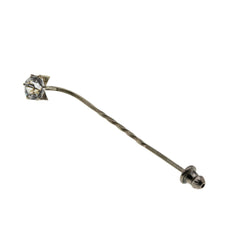 A Touch Of Class - Vintage Rhodium Plate Paste Gemstone Stick Pin Brooch (VBR260)
$25.00
-
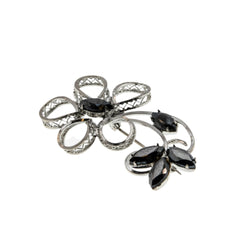 Alaskan Flower - Vintage Signed 'TITAN' Sterling Silver Black Alaskan Diamond Flower Brooch (VBR304)
$45.00
-
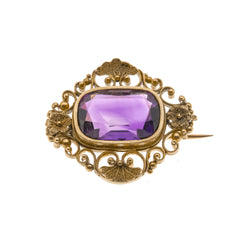 Amethyst Royal - Victorian 14K Gold Amethyst Granule & Scroll Brooch (VICBR003)
$1,295.00
-
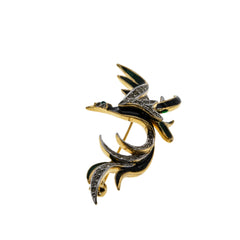 Attwood & Sawyer- Vintage Signed A&S Welch 22K Gold Plated Austrian Swarovski Crystal Rhinestone Enamel Bird Of Paradise Brooch (VBR288)
$295.00
-
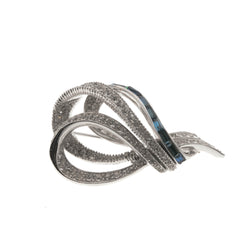 Avon Of Belleville - Vintage Signed AVON (By Marcel Boucher) Rhodium Plated Austrian Swarovski Crystal Rhinestone Brooch & Earring Set (VBR086)
$395.00